
Receiving correspondence from the General Medical Council (GMC) can be unsettling, particularly when it asks for information about your clinical practice, conduct, health or professional relationships. It is natural to wonder what happens next, how long the process may take and whether your medical registration is at risk.
The GMC fitness to practise process is not always linear. Some cases close at an early stage, while others progress through formal investigation, an Interim Orders Tribunal or a full Medical Practitioners Tribunal (MPT) hearing. Interim restrictions may also be sought at any point where the GMC believes urgent action is necessary.
This guide explains the usual sequence after the initial information request. Timescales are indicative only. They can vary significantly depending on the complexity of the allegations, the volume of evidence, parallel criminal or employer investigations, expert evidence and the GMC’s caseload.
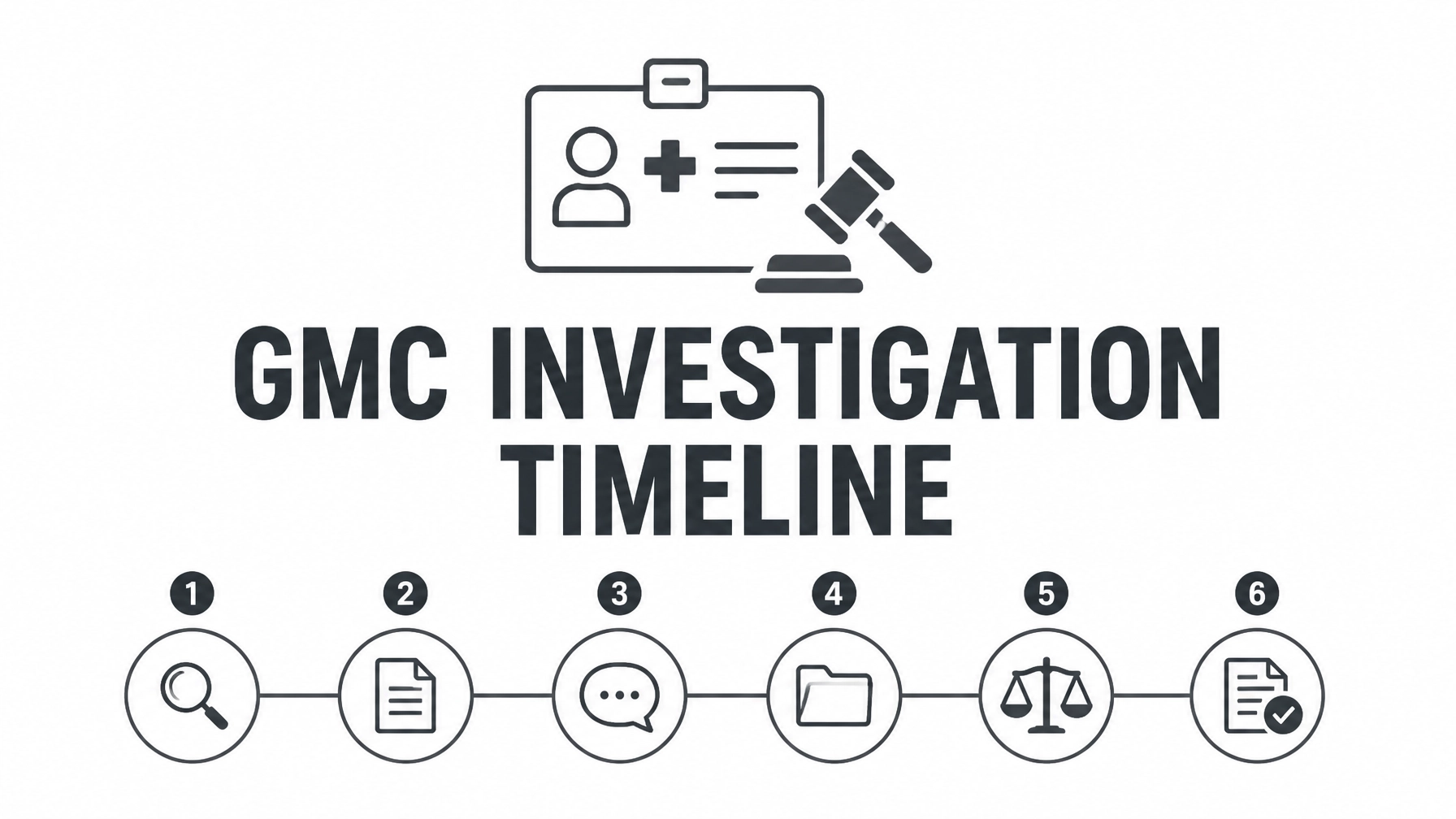
The process at a glance
The main stages are:
- Initial complaint receipt, triage and provisional inquiries
- Formal notification under Rule 7 and the 28-day response period
- Case examiner review and outcome
- Interim Orders Tribunal proceedings, where urgent restrictions are sought
- Medical Practitioners Tribunal fitness to practise hearing
- Section 40 appeal to the High Court or relevant court
The stages do not necessarily occur in a strict sequence. For example, an Interim Orders Tribunal hearing can take place before the investigation has concluded.

Stage 1: Complaint receipt, triage and provisional inquiries
What happens?
The GMC may receive concerns from a patient, colleague, employer, healthcare organisation, police force or another regulator. Concerns can relate to:
- Clinical performance or competence
- Professional conduct
- Dishonesty or integrity
- Criminal convictions or cautions
- Health affecting fitness to practise
- Workplace or professional relationships
- Compliance with regulatory requirements
The first step is usually an assessment of whether the concern falls within the GMC’s remit and whether it could raise a question about your fitness to practise.
The GMC may make provisional inquiries before deciding whether to open a full investigation. This may involve asking you, your employer or another organisation for documents or an explanation. The request may appear relatively informal, but it should not automatically be treated as low risk. Information provided at this stage may later form part of the evidence considered by case examiners.
The GMC’s own investigation process guidance explains that it aims to deal with cases as efficiently as possible, but investigations can take longer where the evidence is extensive or issues are contested.
What should you do?
You should read the request carefully and identify:
- The precise concerns being raised
- The documents or information requested
- The deadline for responding
- Whether there are related employer, police or safeguarding proceedings
- Whether any patient confidentiality or data protection issues arise
Avoid sending a rushed or defensive response. An inaccurate explanation, omission or speculative comment can create difficulties later. You should also preserve relevant records, emails, messages, notes and policies. Do not amend clinical records retrospectively.
Early advice from GMC defense solicitors can help you understand the significance of the request and decide how to respond without unnecessarily expanding the issues.
Stage 2: Rule 7 formal notification and the 28-day response window
If the GMC decides that a full investigation is appropriate, it will normally notify you formally. The process may involve a Rule 4 notification at the point a full investigation is opened, followed later by a Rule 7 letter when the investigation has reached a more advanced stage.
A Rule 7 letter generally sets out the formal allegations and provides the documentation gathered by the GMC. It should give you a clear understanding of the case you are being asked to answer.
You will usually be given 28 days to provide a written response. This is a critical deadline. Your response may be the last opportunity to persuade the GMC to close the case or resolve it without a referral to an MPT.
A properly prepared response should usually:
- Address each allegation separately
- Distinguish between accepted, disputed and unclear matters
- Identify weaknesses or inconsistencies in the evidence
- Provide relevant documentary evidence
- Explain any remediation, learning or corrective action
- Deal with current risk and future practice
- Avoid unnecessary admissions or irrelevant criticism
The response is not simply an opportunity to tell your side of the story. It should be structured around the legal and regulatory questions the case examiners will need to decide.
If the bundle is substantial, evidence is missing or you need expert assistance, an extension may be requested. An extension should not be assumed to have been granted unless the GMC confirms it. If the deadline has passed, seek advice promptly rather than ignoring the correspondence.
This stage is distinct from the earlier information request: the Rule 7 letter normally represents a formalisation of the case and should be approached with appropriate legal support.
Stage 3: Case examiner review and possible outcomes
After receiving your response, the case is considered by two case examiners: one medical and one lay. They review the allegations, the evidence gathered during the investigation and your response.
The case examiners consider whether there is a realistic prospect that the factual allegations could be proved and that a tribunal could find your fitness to practise impaired in a way requiring regulatory action.
Their possible outcomes include:
Closure with no further action
The case may be closed if the evidence does not support further action, the allegations cannot be proved or a finding of current impairment is unlikely.
Closure is not guaranteed simply because you deny the allegations. The quality, relevance and organisation of your evidence can be important in demonstrating why further action is not justified.
A warning
A warning may be issued where the GMC considers that your conduct or performance fell below the required standard, but does not believe that conditions, suspension or erasure are necessary.
A warning is not the same as a sanction imposed after a finding of impairment, but it can remain visible on the medical register for a specified period and may be relevant if later concerns arise.
Undertakings
Undertakings are commitments or restrictions agreed with the GMC. They may address matters such as supervision, training, clinical limitations, health monitoring or workplace arrangements.
You should not agree to undertakings without understanding exactly what they require, how they will operate in practice and what could happen if they are breached.
Referral to an MPTS hearing
The case may be referred to the Medical Practitioners Tribunal Service (MPTS) for a full fitness to practise hearing. This does not mean the allegations have been proved. It means that the case requires determination by an independent tribunal.
The case examiner stage can take weeks or months after your response, particularly where the evidence is extensive.
Stage 4: Interim Orders Tribunal hearings

An Interim Orders Tribunal (IOT) is concerned with immediate risk management while the investigation or hearing process continues. It does not decide whether the allegations are true and does not determine your final fitness to practise status.
The GMC may refer a doctor to an IOT where it believes temporary restrictions are necessary to protect patients, protect the public interest or protect the doctor’s own interests.
The tribunal may impose:
- Conditions on your registration, restricting how or where you practise
- An interim suspension from the medical register
The hearing may be listed urgently. The GMC will present the basis for seeking an interim order, and you will have the opportunity to respond. Depending on the circumstances, the tribunal may consider written evidence, oral submissions and whether a less restrictive order would manage any identified risk.
An interim order can have immediate practical consequences for employment, income, immigration status, reputation and professional relationships. It is therefore important to obtain specialist advice as soon as you learn that the GMC is seeking an interim restriction.
Interim orders are temporary and subject to review. They should not be treated as a final decision about the allegations.
Stage 5: MPTS fitness to practise hearing
If the case is referred, the MPTS will arrange an MPT hearing. The tribunal is independent of the GMC’s investigation team and normally includes medical and lay members.
The hearing generally has three principal phases.
1. Fact-finding
The tribunal considers the allegations and decides which facts, if any, are proved. The GMC must present evidence to support its case. You may challenge evidence, call your own witnesses and provide documentary or expert evidence where appropriate.
The tribunal may hear evidence from patients, colleagues, employers or experts. It may also consider records, correspondence, policies, clinical notes and other documentary material.
2. Impairment
If facts are proved, the tribunal considers whether your fitness to practise is currently impaired. This is not simply a repetition of the fact-finding exercise. The tribunal may consider insight, remediation, reflection, current practice, risk of repetition and whether public confidence in the profession requires action.
A historic mistake does not automatically mean that fitness to practise is currently impaired. However, the outcome depends on the facts and the evidence available to the tribunal.
3. Sanction
If impairment is found, the tribunal considers what action is necessary. Possible outcomes include:
- No action
- Conditions on registration
- Suspension
- Erasure from the medical register
The tribunal must consider the least restrictive outcome that adequately protects the public and maintains confidence in the profession. A sanction may take effect after the applicable period unless an interim order is in place.
Preparation should begin well before the hearing. This may involve reviewing the evidence, preparing witness statements, obtaining expert input, addressing remediation and developing submissions on impairment and sanction.
Stage 6: Section 40 High Court appeals

A doctor may have a statutory right to appeal certain MPT decisions under section 40 of the Medical Act 1983. This can include decisions directing erasure, suspension or conditional registration.
Under section 40 of the Medical Act 1983, an appeal generally must be lodged within 28 days of service of notification of the decision. For doctors whose registered address is in England or Wales, the relevant court is generally the High Court. Different provisions apply to doctors registered at addresses in Scotland or Northern Ireland.
The court may dismiss the appeal, quash the decision, substitute another decision available to the tribunal or remit the case to the MPTS with directions.
An appeal is not an opportunity to run the entire case again without limits. Specialist advice is essential to identify arguable errors in the tribunal’s approach, reasoning, procedure or application of the law, and to protect the deadline.
How long does a GMC investigation take?
There is no single standard timeframe. A straightforward investigation may progress within several months, while a complex case can take considerably longer. Delays may arise from:
- Large evidence bundles
- Difficulties obtaining records or witness evidence
- Expert evidence
- Parallel criminal, employer or safeguarding investigations
- Health assessments
- Requests for further information
- Tribunal listing availability
- Interim order reviews or extensions
A longer investigation does not necessarily mean that the GMC considers the case more serious. Equally, silence from the GMC should not be taken as confirmation that the matter has ended.
Why early legal advice matters
The most effective time to obtain advice is often before you respond to the first substantive GMC request, not after an adverse decision has been made. A specialist legal team can help you understand the allegations, protect confidentiality, prepare evidence, manage deadlines and plan for possible next stages.
Tyndel Solicitors provides advice and representation for doctors facing GMC investigations, interim order proceedings, MPTS hearings and related regulatory issues. Our medical license defense solicitors can assess your position and help you respond strategically.
Contact Tyndel Solicitors about GMC defence and doctors’ regulatory representation.
This article provides general information about the GMC fitness to practise process and is not a substitute for advice on the facts of an individual case. Regulatory rules and procedures can change, so obtain specific legal advice promptly if you have received correspondence from the GMC or MPTS.