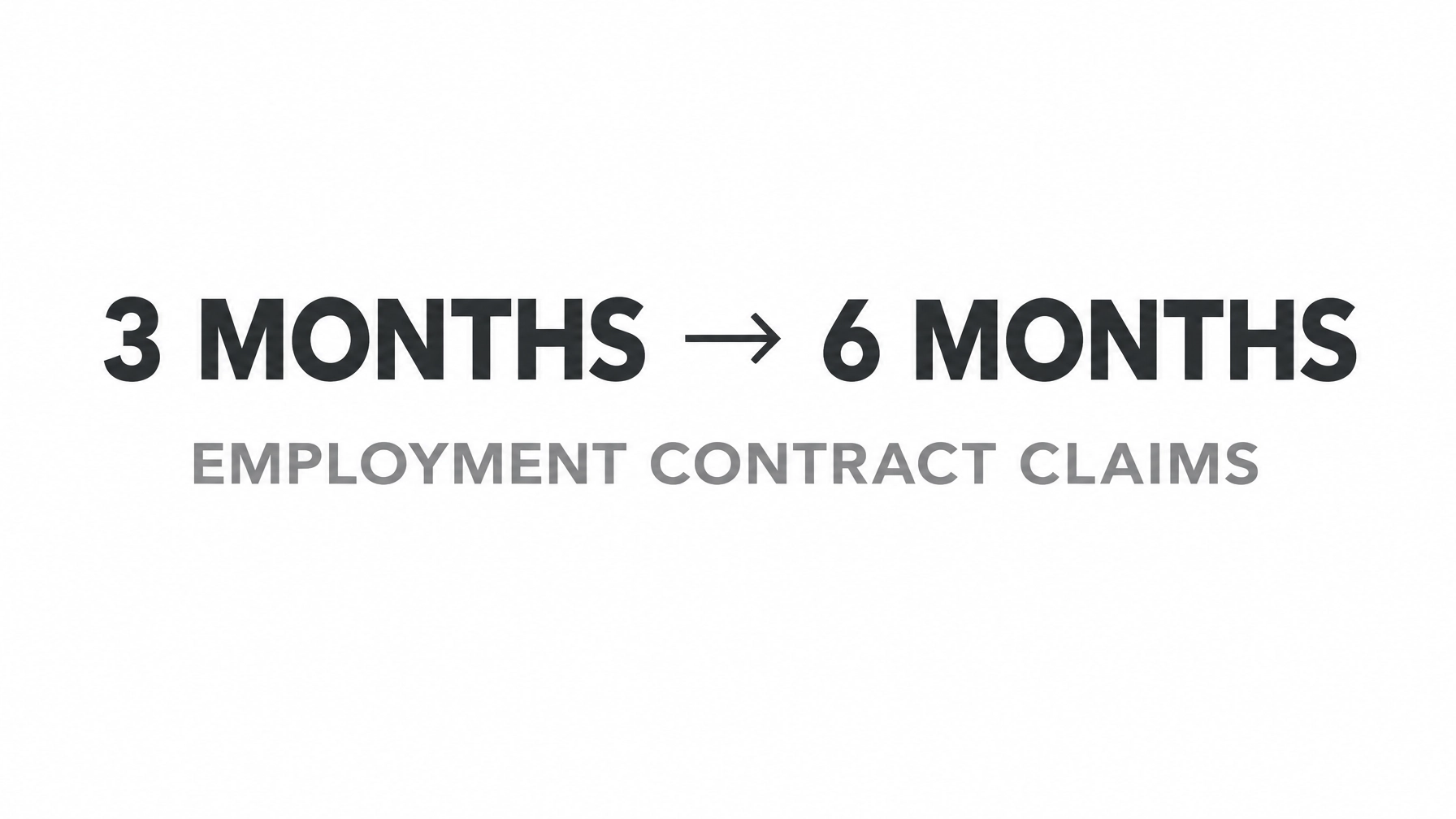
From 1 October 2026, some employees in England and Wales have longer to bring a contractual claim to an Employment Tribunal. The Employment Tribunals Extension of Jurisdiction (England and Wales) (Amendment) Order 2026 changes the relevant deadline from three months to six months for qualifying employment contract claims.
The change matters if you are dealing with a dispute over notice pay, contractual holiday pay or another sum owed under your employment contract. But it does not mean every workplace claim now has six months, or that employees should wait before seeking advice. The correct deadline depends on the type of claim, when the relevant event occurred and whether Acas Early Conciliation applies.
This guide explains the employment tribunal time limit 2026 change, who it covers, and practical steps for employees and employers.

What changed on 1 October 2026?
The Order amends the time limit in the Employment Tribunals Extension of Jurisdiction (England and Wales) Order 1994. For qualifying employee contract claims, it replaces “three” months with “six”.
The new limit applies where the effective date of termination of the contract giving rise to the claim is on or after 1 October 2026. If there is no effective date of termination, the test is whether the employee’s last day working in that employment was on or after that date.
The change is not retrospective. If the relevant termination date was before 1 October 2026, the former three-month limit generally remains applicable to this type of contract claim.
The Order applies in England and Wales. A separate Scottish change is scheduled to take effect on 9 November 2026. Do not assume the rules or start date are identical across jurisdictions.
Which claims may qualify?
The Employment Tribunal’s contract jurisdiction is limited. It is not a general route for every disagreement about work, and it is not available to every worker or self-employed contractor.
Broadly, the route is for an employee bringing a claim about a breach of their employment contract that arises or remains outstanding when the employment ends. Depending on the facts and wording of the contract, examples may include:
- Wrongful dismissal, such as a claim for contractual notice pay where the required notice was not given or paid.
- Holiday pay due under the contract, including accrued contractual holiday pay on termination.
- Unpaid contractual salary or other entitlements, such as a bonus or commission, if the contract makes the payment due.
- Other contractual losses arising from a breach connected with the employment.
Whether a payment is genuinely due under the contract can be important. For example, a bonus may be discretionary or subject to conditions, while commission may depend on specific contractual rules. The facts and relevant documents need to be reviewed before deciding how to frame a claim.
There is also a financial limit: the Tribunal generally cannot award more than £25,000 for a contract claim, or for multiple contract claims relating to the same contract. A claim for unpaid wages or holiday pay might instead be available under a statutory route, depending on the circumstances. The legal basis can affect the deadline, remedies and limits, so it should not be assumed that all unpaid sums are treated alike.
What the change does not cover
The Order concerns a particular kind of contract claim. It does not, by itself, extend every Employment Tribunal deadline.
Other changes to Tribunal time limits also took effect from 1 October 2026 under separate provisions. Acas says that, for most claims based on a workplace problem that happened on or after that date, the time limit is now generally six months minus one day. Claims relating to events before 1 October may remain subject to the previous limit. The precise rule depends on the cause of action and when it arose.
For example, an unfair dismissal claim and a contractual wrongful dismissal claim are not the same thing. They may arise from the same end of employment, but they have different legal tests and may have different deadlines. Likewise, a dispute about employment status can affect which rights are available in the first place. Our guide to worker status, holiday pay and Tribunal claims explains some of those related issues.

How do you work out the deadline?
“Six months” should not be treated as a simple invitation to wait. For many Tribunal claims, Acas describes the deadline as six months minus one day from the relevant date. The date the clock starts depends on the claim: for a contract claim under the Order, the termination rules and transitional provisions are particularly important.
If you need to bring a claim, you will usually need to notify Acas for Early Conciliation before presenting it to the Tribunal. Notifying Acas within the applicable time limit can pause the clock while conciliation takes place. The time limit does not necessarily restart as a fresh six-month period afterwards, so the dates must be calculated carefully.
An internal grievance, appeal, settlement discussion or ongoing investigation does not automatically stop the Tribunal clock. Keep track of the deadline while those processes are taking place, rather than assuming that an employer’s internal procedure gives you extra time.
If you have several potential claims, or the events happened over a period of time, do not calculate a single deadline for everything without checking. Different claims may have different starting points and time limits. Acas provides general information on employment tribunal time limits.
Practical steps for employees
If you think you may be owed contractual pay or another employment entitlement:
- Identify the legal issue. Is the concern about contractual notice, holiday pay, unpaid salary, a statutory deduction or more than one kind of claim?
- Check the relevant dates. Keep your termination letter, notice details, final working date and records of when payments were due.
- Gather the paperwork. Useful documents may include your employment contract, staff handbook, payslips, holiday records, commission terms and correspondence with your employer.
- Do not wait for the full six months. The longer period may not apply to your claim, and a related claim may have a different deadline.
- Consider Acas promptly. Check whether Early Conciliation is required and how it affects your particular deadline.
- Get advice where the route is unclear. This is especially important if you are unsure whether you qualify as an employee, whether a payment is contractual, or whether your potential claim exceeds the Tribunal’s contract award limit.
If your concern is unfair dismissal rather than contractual notice or pay, see our separate guide to unfair dismissal rights and the 2026 changes. That article addresses the distinct rules on unfair dismissal; this one focuses on the time limit change for contract claims.
Practical steps for employers
A longer period for some contract claims makes early record-keeping and dispute handling more important. Employers should:
- Retain employment contracts, variations, pay and holiday records, and relevant termination documents in line with their record-retention policies.
- Preserve relevant emails and messages when a dispute is raised or a claim appears likely.
- Check final pay calculations, including notice, accrued holiday and any contractual commission or bonus.
- Record the reasons for decisions and the steps taken to investigate a complaint.
- Avoid assuming that an internal appeal or grievance pauses a Tribunal deadline.
- Seek advice early if a potential claim involves overlapping contractual and statutory issues.
Good records can help an employer understand the issue, assess the evidence and respond appropriately. A longer time limit is not a reason to delay resolving an apparent payroll or contractual error.

The key takeaway
The change from three months to six months is significant, but it is not a blanket extension for every employment dispute. The 2026 Order applies to qualifying employee contract claims in England and Wales, with transitional rules linked to the effective termination date, or, where there is no such date, the employee’s last day at work. Other claims have their own rules.
Employees should check the claim type and dates promptly, and employers should preserve relevant records and assess disputes early. For related information about compensation and injury-to-feelings awards, read our article on Employment Tribunal compensation and Vento bands.
Tyndel Solicitors advises employees and employers on workplace disputes, contractual claims and Tribunal proceedings. Visit our Employment Law page to learn more.
Request a Free Consultation
If you need advice about a potential employment claim or response, contact Tyndel Solicitors to discuss your circumstances.
Telephone: 020 8154 3131
Email: [email protected]
Office: 58 Peregrine Road, Ilford, IG6 3SZ
Opening hours: Monday–Friday, 10:00–18:00This article provides general information only and is not legal advice. Tribunal time limits are strict and can depend on the facts and applicable claim. Seek advice promptly about your circumstances.
Request a Free Consultation
OFFICE
Office 4571
58 Peregrine Road
Ilford
IG6 3SZ
OPENING TIME
Monday - Friday: 10:00 - 18:00
Saturdays - Sundays & Bank Holidays: Closed
TELEPHONE
Landline: 02081543131
Mobile / WhatsApp: 07918811842
EMAIL
[email protected]