
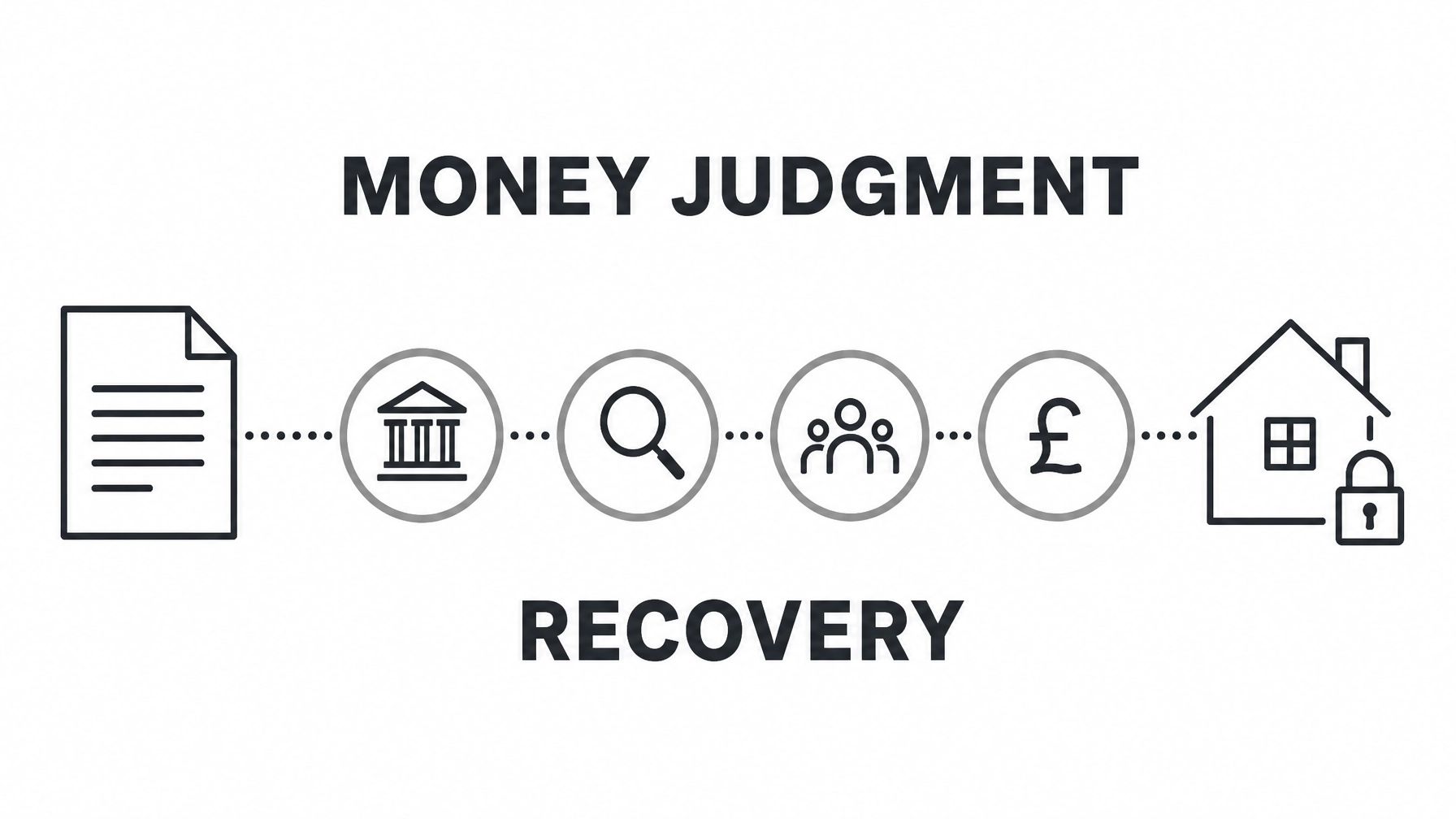
Obtaining a court judgment for rent arrears or another tenancy-related debt is an important step: but it does not automatically put money in your account. If the tenant does not pay voluntarily, you must choose an appropriate enforcement method.
This guide explains how landlords can enforce a money judgment against a tenant in England and Wales, including bailiffs, High Court enforcement, attachment of earnings, third-party debt orders and charging orders. It also explains the limitations of each option and what to consider before incurring further costs.
Important: Enforcing a money judgment is different from recovering possession of a property. A warrant or writ used to recover money does not, by itself, authorise you to evict a tenant. Possession requires a separate lawful process.
Start by checking what judgment you have
Before applying for enforcement, check the judgment carefully. You will usually need a County Court Judgment (CCJ) or High Court judgment ordering the tenant to pay a fixed sum.
Review:
- The amount awarded;
- Any interest or legal costs included;
- Whether payment is due immediately or by instalments;
- The correct name and address of the debtor;
- Whether the tenant is an individual, partnership or company; and
- Whether the judgment has been paid in part.
If the tenant is paying instalments on time, enforcement may not be necessary immediately. However, if payments stop or the arrangement is unrealistic, you may need to take further action.
The official GOV.UK guidance on enforcing a judgment provides an overview of the main procedures. The correct option will depend on the tenant’s employment, assets, bank accounts and financial circumstances.

Option 1: County Court bailiffs and warrants of control
A warrant of control authorises a County Court bailiff to visit the tenant and take control of goods that can be sold to raise money towards the judgment debt.
This may be appropriate where:
- The debt is relatively modest;
- You know where the tenant lives or works;
- The tenant appears to own valuable goods; and
- There is no obvious reason to believe that the property is empty.
The bailiff will generally seek payment or agree an arrangement first. If that does not happen, they may take control of eligible goods, subject to legal restrictions.
Limitations
A warrant of control is not guaranteed to produce payment. It may be ineffective if:
- The tenant has few or no valuable goods;
- The goods belong to somebody else, such as a partner, employer or hire-purchase company;
- The goods are exempt from enforcement;
- The tenant has moved and you do not know their new address; or
- The anticipated sale value is too low to justify the enforcement costs.
You should also remember that a bailiff cannot simply remove everything from a property. There are protections for essential household items and tools required for personal work or business, within applicable limits.
Option 2: High Court enforcement
For qualifying County Court judgments of at least £600, it may be possible to transfer the judgment to the High Court for enforcement by a High Court Enforcement Officer (HCEO). Judgments regulated by the Consumer Credit Act 1974 are treated differently.
Where the total amount being enforced is £5,000 or more, High Court enforcement may be required rather than County Court enforcement. The rules and eligibility requirements should be checked before applying.
An HCEO can enforce a writ of control by seeking payment or taking control of eligible goods. High Court enforcement is often considered where speed is important or where County Court bailiff action is unlikely to be effective.
Limitations
High Court enforcement is not a shortcut around the legal requirements. It can still fail where the tenant has no recoverable assets, has moved, or does not own the goods at the address.
It can also involve additional fees and administrative steps. Although certain enforcement costs may be added to the amount sought, recovery is not assured if the tenant has no funds or assets. You should assess the likely benefit before proceeding.
High Court enforcement also does not give you permission to enter unlawfully, harass the tenant or change the locks. Money recovery and possession remain separate matters. Tyndel’s guidance on why landlords should avoid DIY evictions explains the risks of taking matters into your own hands.
Option 3: Attachment of earnings
An attachment of earnings order requires deductions to be made from an individual debtor’s wages. The employer sends the deductions to the court, which then forwards them to the creditor.
This may be useful where:
- The tenant is an individual;
- They are employed under PAYE;
- You know, or can establish, where they work; and
- There is a realistic amount available after essential living expenses.
For a civil debt, an attachment of earnings application is generally dealt with through the County Court. It may be available for a judgment that originated in the High Court, but the procedure and forms must be checked carefully.
Limitations
This method cannot normally be used against:
- A tenant who is unemployed;
- A self-employed tenant;
- A company; or
- A person whose income is too low to permit meaningful deductions.
Even where an order is made, deductions may be small. If the tenant changes employer, leaves employment or becomes self-employed, recovery may stop or require further steps.
You should avoid assuming that an individual landlord or tenant is receiving a regular salary. Income may instead come from dividends, benefits, investments or cash work, none of which necessarily supports an attachment of earnings order.

Option 4: Third-party debt order
A third-party debt order can be used to target money owed to the tenant by somebody else. The most common example is money held in the tenant’s bank or building society account.
The court may first make an interim order freezing funds. A later hearing will determine whether a final order should be made to pay money towards the judgment debt.
This method can be effective where:
- You know the bank or building society used by the tenant;
- The account is likely to contain sufficient funds; and
- The money is not already committed or subject to another legal restriction.
A third-party debt order may also be relevant where a business owes money to the tenant, although identifying and proving the debt can be more complicated.
Limitations
The order is not a general search for money. You need sufficient information to identify the relevant third party, and funds may not be available when the bank receives the order.
The account may be overdrawn, contain protected or jointly held funds, or be subject to competing claims. A tenant may also move money between accounts before enforcement is completed.
For these reasons, it is important to consider whether you have reliable intelligence before paying an application fee.
Option 5: Charging order over property or other assets
A charging order secures a judgment debt against an asset, commonly land or property owned by the debtor. It can also apply to certain other assets, such as shares.
This may be worth considering where the tenant owns:
- A home;
- A buy-to-let property;
- Land; or
- Another asset with sufficient equity.
A charging order does not necessarily result in immediate payment. It protects your position by recording the debt against the asset. In appropriate circumstances, you may later apply for an order for sale.
Limitations
A charging order is not the same as receiving the money. There may be:
- A mortgage or earlier charge;
- Little or no equity;
- Other creditors;
- Joint ownership issues; or
- Practical and legal barriers to obtaining an order for sale.
The property may also take many years to sell, meaning that this method is often better for securing a debt than for dealing with an urgent cash-flow problem.

What to consider before spending more money
Enforcement should be treated as a commercial decision as well as a legal one. Before applying, consider:
Does the tenant have anything to enforce against?
Check whether you know their current address, employer, bank, business or property ownership.How much is realistically recoverable?
A large judgment does not mean the tenant has the means to pay it.What will the process cost?
Consider application fees, enforcement fees, legal costs and the time involved. Costs may not be recoverable if enforcement fails.Are there other creditors?
Bankruptcy, insolvency, existing charging orders and priority debts can affect recovery.Is the tenant making any payments?
A voluntary arrangement may produce better results than immediate enforcement if the tenant is engaging and the proposed payments are realistic.Do you need possession as well as money?
If the tenant remains in the property, you may need separate possession proceedings. Do not use enforcement agents as a substitute for lawful eviction.
Practical recovery tips for landlords
Keep a complete evidence file, including:
- The tenancy agreement;
- A clear rent statement;
- Copies of invoices or other sums claimed;
- The judgment and any payment order;
- Records of payments received;
- The tenant’s current contact details;
- Information about employment, assets or bank accounts; and
- All correspondence about repayment.
Update the arrears schedule before taking action. A tenant may have made payments since judgment, and attempting to recover the wrong amount can delay enforcement.
Communicate professionally and in writing. A realistic repayment proposal can sometimes resolve the matter more quickly than a contested enforcement application. However, do not accept vague promises indefinitely where the tenant is not paying.
If the judgment arose from rent arrears, read Tyndel’s related guidance on landlord and tenant disputes and possession and the site’s article on rent arrears issues under the changing renters’ rights framework.
How landlord and tenant solicitors can help
The most effective enforcement method depends on facts that may not be obvious from the judgment itself. Landlord and tenant solicitors can review the debt, assess the tenant’s likely means, explain the risks and prepare the appropriate application.
Tyndel Solicitors can advise landlords on judgment enforcement, rent arrears, possession proceedings and related landlord and tenant disputes across England and Wales.
Contact Tyndel Solicitors about landlord and tenant legal advice.
This article provides general information for landlords in England and Wales. Enforcement rules and the most suitable procedure depend on the judgment, the debtor and the available assets. Obtain advice on your specific circumstances before taking action.